TL;DR
- 5 new Corp Dev and M&A roles this week, including Anthropic and Galaxy
- Market Pulse: Capital must deploy, but buyers still refuse to overpay
All content is written by me, with research pulled from online sources and AI. Sources are listed where possible. Some sections include photos and graphs generated to complement the articles.
This Week's Roles
This week's hand-picked roles across Corporate Development, Corporate Strategy, and Buyside M&A:
Senior Manager, Corporate Development
Armanino
Internal M&A seat at one of the top 20 US accounting and consulting firms, executing Armanino's own acquisition strategy. Owns deal evaluation, financial modeling, diligence coordination, and integration readiness, and manages a team of two.
Director, Technical Accounting — M&A and Investments
Anthropic
Corp-dev adjacent builder role owning purchase accounting and deal-side technical positions for one of the most active acquirers in AI, partnering directly with Corporate Development on structuring.
Associate, Corporate Development
Harris Computer (Frontline Portfolio)
Newly created origination role inside Constellation Software's largest operating group, focused on the public safety software vertical. Hunter mentality required — cold outreach, founder conversations, and pipeline building, with direct exposure to the Constellation playbook.
Head of M&A
Solen Software Group
Senior seat reporting directly to the CEO of an evergreen VMS holdco. Owns the deal lifecycle end to end — thesis, underwriting, diligence, negotiation, and post-close support. 7+ years of software M&A required.
VP, Strategy & Corporate Development
Galaxy
First non-North American role we've featured. Senior seat at Michael Novogratz's digital assets and AI infrastructure platform, leading transaction execution across investments, acquisitions, and JVs spanning crypto and data center infrastructure.
M&A in 2026: The Dry Powder Dilemma
The Deployment Paradox
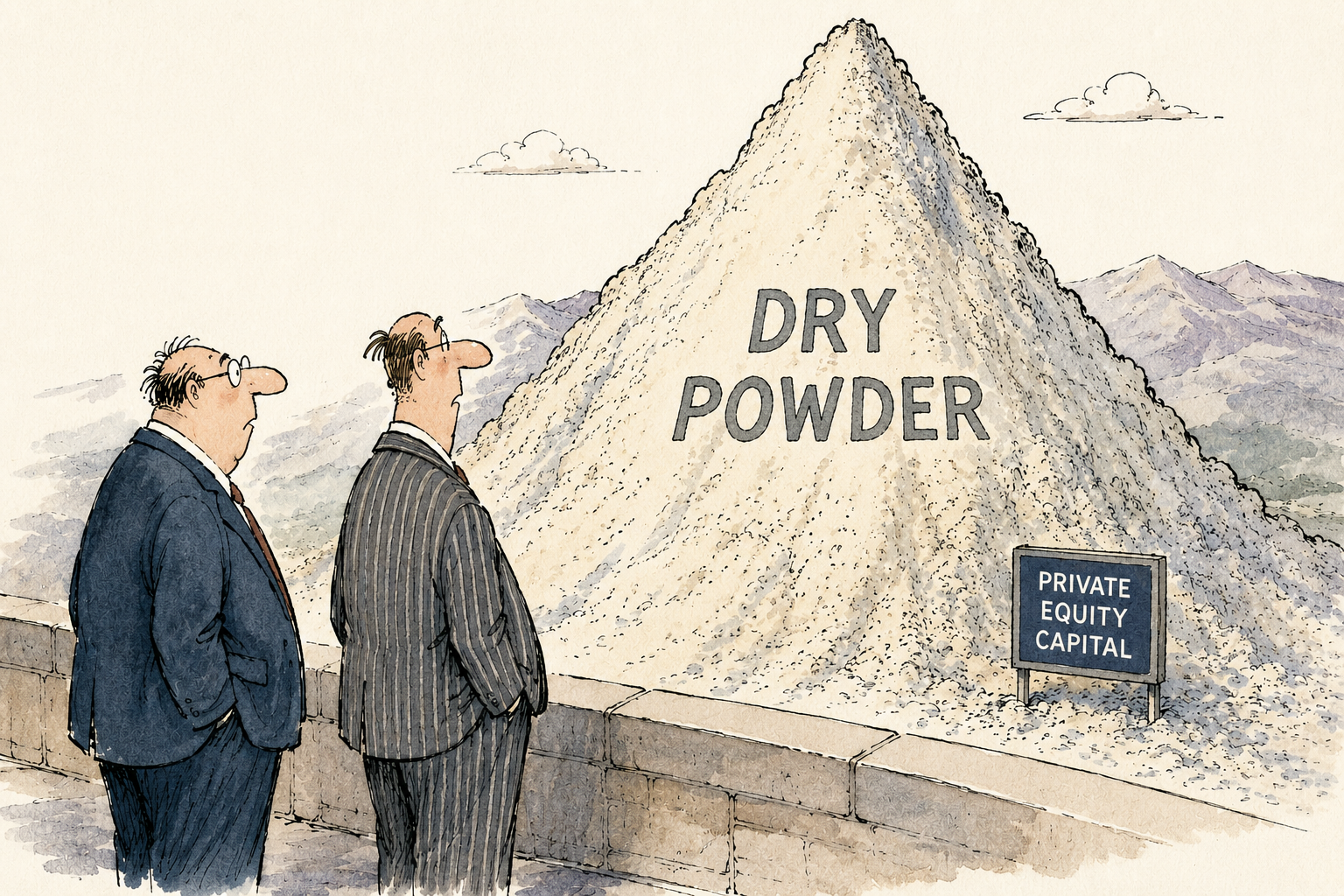
Private equity in 2026 faces a strange contradiction. Firms are sitting on historically high levels of undeployed capital, yet many sponsors remain reluctant buyers. On the surface, these facts appear incompatible, but in reality they reflect two forces pushing in opposite directions. In issue three, we discussed how deal value is increasing asymmetrically to deal volume — this is a notable side effect of the structural dynamic.
Finding Deals for the Right Price
The KPMG 2026 M&A Deal Market Study, which surveyed 150 PE and 150 corporate dealmakers, found that 43% of PE dealmakers describe their primary strategy for deploying dry powder in 2026 is maintaining price discipline, even at the cost of slower deployment. KPMG calls this an optimistic but intentional approach.
It isn't pessimism. Sponsors have watched many 2021-vintage deals struggle and concluded that the bigger risk is buying the wrong asset for the wrong price, not deploying capital too slowly.
The same study found that a majority of those same firms want a 100–150 basis point rate cut before they meaningfully start ramping up activity. Similar findings were produced from KPMG's contemporaries. BDO's 2026 predictions describe disciplined GPs focusing on pricing, operational value creation levers, and selective deployment in sectors with durable fundamentals. Ocorian's private capital outlook labels the prevailing sentiment as "tempered optimism".
Opposing Force: The Growing Powder Reserve
On the other side of the equation, US private equity is holding roughly $1 trillion in committed-but-undeployed capital, per EdgePoint's February 2026 estimate. Pitchbook's data shows that about 50% of dry powder sits in funds between two and five years old — largely similar to the previous quarter.
The reason the length of time the capital is held matters is because most firms operate on defined investment periods. There is a finite limit on how long they can continue calling capital. Money committed in 2022 and 2023 has a deadline, and this is why several forecasters expect deployment to accelerate regardless of where rates land. As investment periods mature, GPs face increasing pressure to either deploy capital or release it unused — an outcome few will find desirable.
So which force wins? From what we're seeing, neither is cleanly winning. Instead, the data is showing that deal value continues to rise while deal volume stays relatively flat. Rather than forcing capital into numerous smaller transactions, firms are making their bets on larger, higher-conviction deals. Sponsors are deploying because if they don't they'll lose out, and they're being more selective because if they don't they'll get burned.
Why This Matters for M&A Professionals
A market where capital must deploy but buyers refuse to overpay concentrates activity into fewer, higher-conviction deals. For M&A professionals, this raises the value of judgement. That means screening effectively, underwriting quality quickly, and pricing with discipline when the deployment clock is pushing the other way.
Sources: KPMG 2026 M&A Deal Market Study (April 2026); BDO 2026 Private Equity Predictions (January 2026); Ocorian Private Capital Outlook 2026 (March 2026); EdgePoint (February 2026); PitchBook Global Dry Powder Dashboard (2026); West Monroe, via Fortune (2026).
In Memory of Lola

Today's issue is in memory of our beloved Lola, who passed away surrounded by those she loved on May 20th.
Thank You
Thanks for the support — it means a lot. Consider sharing with your network, or providing feedback here: corpdevcareers.com/contact
I post every Thursday. Subscribe to get the next issue delivered to your inbox.
— Liam